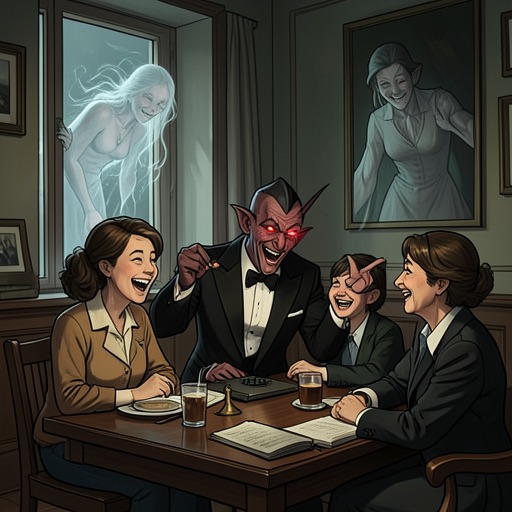
Viago–Katherine relationship
A History of the Vampire in Popular CultureThe Viago–Katherine relationship is one of What We Do in the Shadows’ clearest examples of its method: it places an immense supernatural premise inside the awkward routines of ordinary romance. Viago has lived for centuries as a vampire, while Katherine has continued through a normal human lifespan, yet his attachment to her never disappears. Their reunion offers the possibility of permanence, but only through the act that defines vampiric intimacy as both devotion and violence: Viago must kill Katherine in order to transform her and keep her with him forever.
Identity and Background
Viago’s love for Katherine belongs to the film’s running backstory rather than to its central household quarrels. He is a member of the vampire household shared by Viago von Dorna Schmarten Scheden Heimburg, Deacon Brucke, Vladislav, and Petyr, but his emotional life is oriented toward the human woman he left behind. Katherine is not presented as a legendary immortal or a conventional supernatural heroine. She is now ninety-six years old and living in supported accommodation, a fact that makes the passage of time visible through the relationship itself.
That contrast gives the romance its distinctive shape. Viago has remained physically young while Katherine has grown old, so the pair occupy radically different positions within time. He possesses the supernatural capacity to preserve youth, but he has not used it to erase his separation from her. Instead, he has carried the relationship across decades of human aging, allowing his longing to persist while Katherine becomes an elderly woman. The relationship therefore joins a familiar romantic desire for reunion to the specifically vampiric fantasy of escaping mortality.
Longing, Surveillance, and Reunion
Viago often spends his evenings watching through Katherine’s windows. The behavior is recognizably romantic in its persistence but unmistakably disturbing in its method, and the evidence explicitly compares it with Edward Cullen’s stalking behavior in Twilight. Viago’s immortality does not make him emotionally wiser or socially less awkward; it gives his unresolved attachment an almost comically extended duration. His watchfulness turns separation into a habit, preserving intimacy at a distance while avoiding the direct encounter that might force the past into the present.
The relationship changes when Viago finally confesses everything to Katherine. This confession transforms the dynamic from unilateral observation into mutual recognition. Katherine accepts that Viago is a vampire and agrees to let him turn her so that they can finally remain together forever. The expected obstacle is not her age, nor the centuries separating their bodies, but the necessity of vampiric transformation. What looks at first like an impossible reunion becomes possible precisely because Katherine consents to enter Viago’s condition.
The Age-Gap Exchange
The couple discuss their age difference with an innocence that deliberately reverses ordinary social expectations. Viago notes that some people are disturbed by the fact that Katherine is ninety-six while he is four times her age, and he dismisses the criticism by calling himself a cradle snatcher. Katherine answers that the difference makes no difference. Their exchange is funny because it treats an extraordinary chronology as if it were an ordinary social embarrassment, while also revealing how completely both characters accept the logic of their relationship.
The joke depends on a literal inversion of the usual age-gap concern. Viago looks young but is vastly older, whereas Katherine looks elderly but is the younger partner by the arithmetic of their lives. The film refuses to make that reversal a source of shame. Instead, the couple’s calm agreement gives the relationship a mutuality that contrasts with Viago’s earlier habit of watching her from outside. Their love is not made acceptable by pretending that time has no meaning; it becomes acceptable within the film because both partners acknowledge the difference and choose each other anyway.
Transformation and Moral Contradiction
The ending carries the relationship toward eternal companionship, but it does not cleanse the romance of its violence. Viago has to kill Katherine in order to keep her with him. The transformation is simultaneously a rescue from human mortality, an act of murder, and the fulfillment of a promise that has been deferred for most of his existence. The film allows these meanings to remain together rather than resolving them into a simple happy ending.
That contradiction is handled in a light-hearted and joyful register. The couple’s innocence lies partly in their refusal to treat murder as an exceptional moral rupture; within their world, it is simply the practical means by which an immortal creature preserves a loved one. The result is darkly comic because the language of romance remains gentle while the action required by the romance is lethal. Their future together is therefore a vampiric version of eternal love: emotionally sincere, formally grotesque, and dependent on the conversion of a human life into undead existence.
Narrative and Thematic Significance
Viago and Katherine embody the film’s larger contrast between the monstrous and the mundane. The vampire household argues, sulks, worries, and pursues romantic reconciliation much like any group of ordinary people, even though its members are undead. In this relationship, the banal language of age-gap anxiety and enduring affection coexists with surveillance, killing, and supernatural transformation. The film’s comedy does not remove the horror; it makes the horror familiar enough to expose how easily affection can normalize it.
The relationship also belongs to a broader history of changing vampire representation. Earlier vampire fiction established the creature as a nocturnal predator, while later works increasingly made vampires selective, elegant, sympathetic, or capable of becoming whatever modern audiences want them to be. Viago’s attachment to Katherine participates in that sympathetic development, but it retains the genre’s central cost. Eternal life is not a neutral gift. It requires the loved human to abandon ordinary mortality, and it binds devotion to predation.
In that sense, Viago and Katherine are neither a purely conventional couple nor merely a parody of one. Their reunion preserves the romance plot’s promise that separated lovers can be together at last, while the vampire framework alters every moral and temporal assumption behind that promise. Katherine’s acceptance gives the ending its tenderness; Viago’s need to kill her gives it its unsettling aftertaste. The relationship’s decisive achievement is to make those two responses inseparable: eternal love appears at once as a joyful commitment and as an act that can only exist because death has been made into the condition of togetherness.